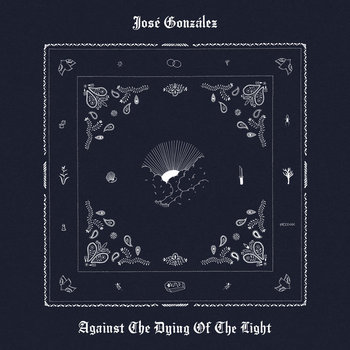
José González "Against the Dying of the Light"
José González has delivered a new album, Against the Dying of the Light, a companion and further meditation on the themes of his critically acclaimed album, Local Valley. Where Local Valley turned inward toward place, language, and personal reflection, this new record widens its gaze, becoming an urgent call to preserve the light of humanity with all its flaws, at a moment when, technology increasingly shapes how we think, feel, and relate to one another.
While José has always embraced technological advancement, he questions the assumption that every new possibility must be pursued to its maximum potential, especially when progress comes at the expense of human flourishing, attention, and empathy.

Joshua Abrams "Music For Pulse Meridian Foliation"
Joshua Abrams’ Music for Pulse Meridian Foliation is the aural manifestation of an art event described as “an in-between space and access point to a pulsating experience that connects body and land.” Like the action of a slow-spiraling coil, the music information here revolves in dappling light, an evolution drawn slowly, magnetically forward, resonating there and back again. Deep-reaching in elemental movement, it leaves traces and echoes in the air—and in our ears, as our own experience evolves.
When playing with Natural Information Society, Joshua’s writing is directed toward the form of the music as uniquely occupied by the group. Here, he wrote in strict dialogue with the exhibit, responding with choices in composition, performance and production on Music for Pulse Meridian Foliation. A key interpretation of the exhibition is voiced by Josh in the hand-off of information between the two violas as they weave together from oppositional points across the sound stage.
On Music for Pulse Meridian Foliation, Lisa Alvarado asks, “How does memory transform and live within the body?” and, in collaboration with Joshua Abrams, a transformation is enacted.
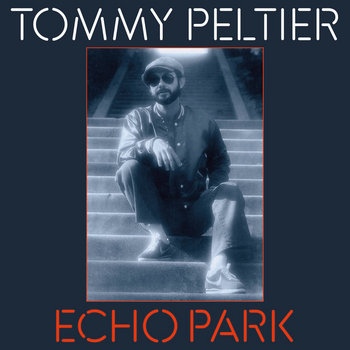
Tommy Peltier "Echo Park (The 70’s Sessions)"
Tommy Peltier’s Echo Park, compiled of unheard tapes from the early/mid 1970s, brings us into contact with a long-extinct creature — equal parts slinky hipster, universal soldier of the heart and snuggly loverman — the light-rockin’ tinseltown troubadour, the likes of which hasn’t been served around Hollywood since 1979! Tommy’s somewhere in the tuneful tradition of Rupert Holmes, Stephen Bishop, Andrew Gold, David Batteau and of course, Captain Fantastic and the Thin White Duke. His soulful songs and high-pitched vocals (he was once called “Tom Rapp on helium”) are paired with the requisite chopsy, jazz-enriched LA players, entrancing the ear with grooves and performances both tasty and sweet. Mixed and mastered with great zest by Jim O’Rourke (he brought new life to recordings of a similar vintage for Judee Sill’s posthumous Dreams Come True back in 2005), Echo Park is an encompassing trip through a whole other time and place.
Tommy has continued to play music, releasing new stuff with Plastic Theatre Art Band in 1996, and a number of releases under his own name, most recently in 2011. And at the ripe young age of 90(!), he’s still playing today! Mixed and mastered by Jim O’Rourke, Echo Park is a high-flying journey through the past.
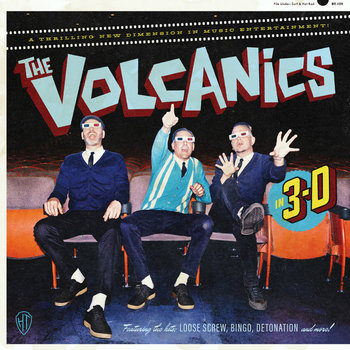
The Volcanics "In 3-D"
Hold on to your popcorn folks! The Volcanics are back and this time they’re IN 3-D! Straight from the SoCal surf strip – Frankie, Jarrod, and Ben are a TRIPLE FEATURE that bursts out of your screen in a technicolor tidal wave of reverb and radioactive rhythm! So grab a seat, dim the lights, and don’t forget your 3-D glasses – the show’s about to begin!