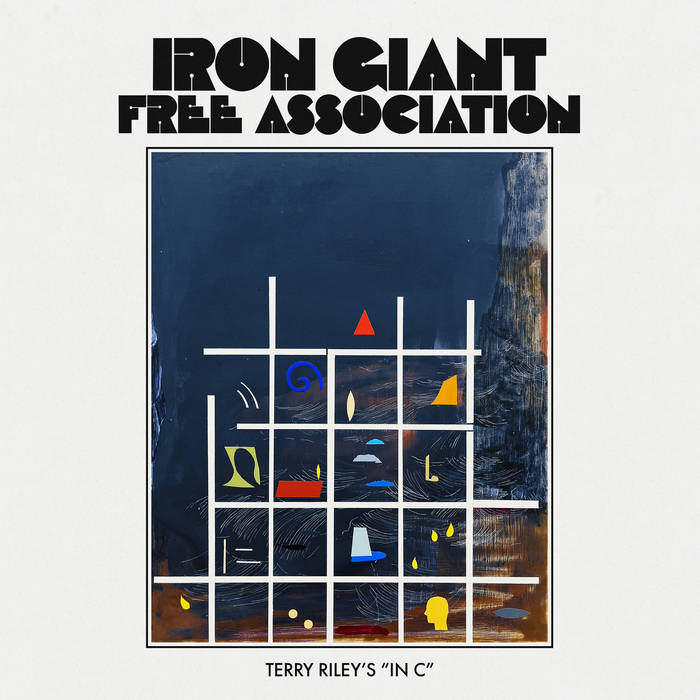
Iron Giant "Terry Riley’s In C"
The debut album from Birmingham-based music collective Iron Giant Free Association is the culmination of their decade-long relationship with Terry Riley’s 1964 minimalist masterwork, In C. What began as an interest in large-scale multi-instrumentation evolved into years of experimentation and collaboration with Riley’s revolutionary piece.
On stage, they gradually began incorporating elements of improvisation, fixed arranging, and rhythmic/ harmonic manipulation until eventually the piece took on a distinct character-something uniquely their own. In the studio (i.e., their own homes) they would meticulously document this over the course of a year. Hypnotic percussion, swells of synthesizers, mutated AM/FM radios, and punchy bass all emerge in a reimagining of In C unlike any before it.
credits
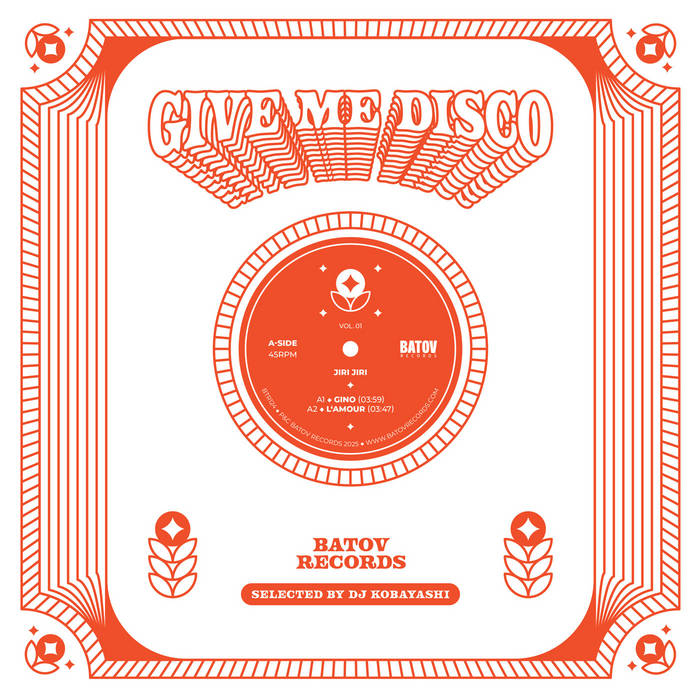
Jiri Jiri "Give Me Disco Vol. 1"
Mysterious disco outfit Jiri Jiri deliver an essential EP — four tracks of sublime, summery European cool hand-picked by Batov Records boss DJ Kobayashi for the label’s brand new and carefully curated ‘Give Me Disco’ 12” series, named after Raja Zahr’s disco classic.
Springing from the ranks of global grooves ensemble Muito Kaballa and psychedelic travellers YĪN YĪN, Jiri Jiri have honed their musical chops and crafted four Neapolitan funk and pan-European disco jams as hot as the Adriatic coastline.
The ‘Give Me Disco – Vol. 1’ EP marks the beginning of two exciting new ventures — the emergence of Jiri Jiri, and inspired by their need for a home, the launch of Batov Records’ ‘Give Me Disco’ 12” series.

Mark Stewart "The Fateful Symmetry"
The groundbreaking, enduringly influential artist Mark Stewart presents his eighth solo album The Fateful Symmetry, a vital new masterwork completed shortly before his untimely passing in April 2023.
Across an illustrious career of pioneering music with The Pop Group, Mark Stewart & The Maffia and as a solo artist, Stewart has produced a seminal body of work, galvanized by the DIY ideals of punk, radical politics, protest movements, theory, philosophy, technology, art and poetry. With The Fateful Symmetry, Stewart’s abiding legacy as a ‘“revered countercultural musician” (The Guardian) is sustained, with an album as fearless and visionary as his best work.
Testifying to his prolific, unrelenting ingenuity, and signifying one of his most intimate, empowering statements, The Fateful Symmetry is an astonishingly expressive and innovative record; a fierce and beautiful manifesto for a better world. The inimitable, titanic Mark Stewart, never normalized, always extraordinary.

Sister "Two Birds"
Sister.’s sophomore album Two Birds showcases a band pushing toward a fresh and cathartic communal vision. The story of the NYC indie band (Ceci Sturman, Hannah Pruzinsky (h. pruz), James Chrisman)’s development is a testament to the deep, almost unfathomably close personal and artistic bond between lead singers Sturman and Pruzinsky over the course of a decade. As the two songwriters began to explore their own relationship in their work, they embarked down a path of total, mutual honesty, writing crystalline indie-folk songs exploring the rare beauty of profound and close friendship, as well as its pitfalls. Two Birds is produced by Chrisman and co produced by Sturman, Pruzinsky, and Felix Walworth (Told Slant, Florist). The project, now expanded into a mature, fully formed quartet—pushes definitively into unexplored emotional and musical terrain.
Here, Sister. have accomplished a rare feat, turning in a collection of songs full of windswept space, patient arcs, and cathartic moments of release, in which new interactions within the music reveal themselves with repeated listening. It is an inventive, devastating, and confident statement, exploring relationships that drift apart before folding back into each other, embodying togetherness and apartness in both its lyrics and musical forms.